

ED Overcrowded? Fix Throughput, Staffing & Revenue — Register Now ED Overcrowded? Fix Throughput, Staffing & Revenue — Register Now ED Overcrowded? Fix Throughput, Staffing & Revenue — Register Now
IHO Monthly Newsletter — July 2026
Monthly Newsletter July 2026

Bridging the gap between healthcare delivery and management science

Through innovative strategies, we enhance healthcare delivery and management, optimizing operations to achieve better patient outcomes and overall efficiency.

In this issue:

•  AI and Your Data – Ensuring Actionable Insights

•  Hospital Crowding: A Major Patient Safety Concern

•  Data Matters: Do you have what it takes to smooth your elective surgical schedule?

AI and Your Data - Ensuring Actionable Insights

AI and Your Data – Ensuring Actionable Insights

Do you have the Right Inputs to get the Right Outputs?

AI is rapidly changing the landscape of hospital analytics. Data may be processed quicker, and analytics generated with greater ease than ever before. However, AI cannot fix the most important things – the data that’s available and the accuracy of that data.

Hospitals continue to struggle to capture the data that would allow for the greatest insights into operational planning and management – and are frequently unable to differentiate between what SHOULD happen and what DID happen –the real waits and delays that exist, and the true potential impact of process improvement. Is your hospital able to accurately track wait times along the care pathway?

As you undertake any AI implementations, let the Institute for Healthcare Optimization help you understand how to get the most out of your analytics, by evaluating both WHAT data is needed and HOW to capture it to ensure the best insights. Schedule a call to learn more >>
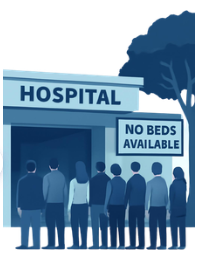

Hospital Crowding: A Major Patient Safety Concern

It has been 25 years since 15-year-old Lewis Blackman died after an elective surgery. The hospital was full, and rather than finding a bed on the usual post-op unit for his surgery, he was placed on a suboptimal unit with staff that was unprepared to manage his care and understand life-threatening signs and symptoms.

Although much work has been done on patient safety since this time, hospital crowding is still a challenge. Fortunately, we are now aware that hospitals have the capacity to reduce peaks in elective admissions through surgical schedule smoothing, which can significantly reduce dangerously high census, ensuring the right bed for the patient when needed.

Hospital Crowding

A Proven Strategy to Improve Inpatient Bed Access

Data Matters

Data Matters

Do You Have What it Takes to Smooth Your Elective Surgical Schedule?

When planning to implement smoothing of your elective surgical schedule, it is critical set your organization up for success to fully optimize scheduling to improve patient throughput and access. The following are some of the most important pieces to identify:

•  Patient type: Only elective (scheduled) patients can be smoothed, making them the ideal population for scheduling algorithms designed to reduce avoidable peaks.

•  Demand categorization: Patients who require similar downstream resources should be smoothed as a group — for example, elective admissions that will need beds on post-op ICU, cardiac, or orthopedic units.

•  Expected length of stay or visit length: Projecting length of stay accurately at the time of booking helps hospitals match demand to available beds, staff, and procedural capacity across the week.

•  Timely communication: Smoothing only works when planned admissions, bed needs, discharge expectations, and staffing implications are shared early and consistently across perioperative teams, inpatient units, and case management.

IHO has worked with numerous hospitals to ensure they have the data to get surgical smoothing implementation right.

Missed our recent webinar? Catch up by watching it here:

The Institute for Healthcare Optimization’s Patient Flow Assessment Program is now currently enrolling hospitals. Please reach out for more information:

Enroll in The Institute for Healthcare Optimization’s

Patient Flow Assessment

Individualized assessment of your hospital:

•  Individualized analysis based on your own hospital’s data

•  Identify and quantify bottlenecks in patient flow

•  Identify and quantify sources of artificial variability

•  Identify real solutions proven to:

◦  Improve timely patient access, placement, and throughput

◦  Improve clinical patient outcomes and experience

◦  Improve work-life balance for providers and staff

◦  Improve financial outcomes

Who is the Institute for Healthcare Optimization:

The Institute for Healthcare Optimization (IHO) is an independent not-for-profit research, education and service organization focused on bringing the science and practice of operations management to healthcare delivery

IHO has a 20+ year history of helping hospitals and healthcare delivery organizations improve operational efficiency in patient flow while simultaneously improving patient outcomes and staff work balance.

IHO is a consulting leader, using state-of-the-art analytics to help healthcare leaders fully understand their operations, and to identify optimal solutions to complex problems around capacity planning, staffing, and operational process design.

Recommended Reading

Optimizing Patient Flow book cover Advanced Strategies for Managing Variability to Enhance Access, Quality, and Safety Ed. Eugene Litvak
JCR Publisher
Hospital corridor - patient transport Spreading Out Elective Admissions Could Save Lives, Strengthen Hospitals, and Reduce Health Spending STAT News
March 2026
Hospital Overcrowding Makes Safe Care Impossible - KevinMD.com Hospital Overcrowding Makes Safe Care Impossible Kevinmd.com
July 2026
Questions? Schedule a call with our Optimization Team Schedule a call

How much could IHO save your hospital?

Find out with our ROI estimator

ROI Estimator